
If you’re leading a technical post-sales team in 2026, your role has changed dramatically. Customers no longer expect implementation support alone—they expect strategic guidance on AI adoption, developer tooling, workflow automation, and long-term business outcomes. The most successful technical post-sales leaders are combining deep technical expertise with AI-driven decision-making, developer experience (DX), and enterprise AI implementation strategies.
I’ve spent years following enterprise software trends, AI platform evolution, developer tooling, and customer success engineering practices. One pattern has become clear: organizations that invest in AI-ready post-sales leadership consistently achieve faster product adoption, stronger customer retention, and more successful enterprise implementations.
Whether you’re a Customer Success Engineering Manager, Solutions Architect, Technical Account Manager, Technical Consultant, or leading an enterprise implementation team, mastering the right AI competencies has become a competitive advantage—not just a nice-to-have.
Quick Answer: Which AI Skills Do Technical Post-Sales Leaders Need?
Technical post-sales leaders in 2026 need much more than traditional implementation skills. The highest-performing professionals combine technical post-sales leader competencies, AI developer tooling leadership, strategic consulting, automation expertise, developer productivity knowledge, and strong cross-functional communication.
The most valuable competencies include:
- AI developer tools expertise
- Developer tooling platforms knowledge
- AI workflow automation
- Customer success engineering
- AI implementation leadership
- Technical consulting AI
- AI integration strategy
- Platform engineering fundamentals
- API integrations
- Developer experience (DX)
- Stakeholder management
- AI solution architecture
- Enterprise AI tools adoption
- Developer productivity optimization
- AI-powered software development understanding
These skills help organizations reduce implementation time, improve customer onboarding, increase product adoption, and deliver measurable business value.

Why Are Technical Post-Sales Leaders Becoming AI Leaders?
The answer is simple: customers expect more than technical support.
Five years ago, post-sales teams mainly focused on onboarding, troubleshooting, integrations, and training. Today, enterprise customers want strategic AI guidance throughout the customer lifecycle.
Modern customers ask questions like:
- Which AI coding assistants should our developers use?
- How can we automate repetitive workflows?
- Which developer platform fits our engineering team?
- How should we integrate AI into existing software?
- What developer productivity tools provide the biggest ROI?
- How do we govern enterprise AI safely?
Instead of escalating these conversations to product teams, companies increasingly expect technical post-sales leaders to answer them directly.
That shift has transformed the role.
Today’s technical leaders must understand both technology and business outcomes.
Instead of saying:
“Here’s how the API works.”
They now explain:
“Here’s how this AI workflow will reduce manual effort by 40% while improving developer productivity.”
That consultative mindset separates exceptional leaders from average implementation managers.
What Does a Technical Post-Sales Leader Actually Do in 2026?
The role has expanded far beyond implementation.
Modern technical post-sales leadership combines elements of:
- Solution Engineering
- Customer Success Engineering
- AI Solution Architecture
- Technical Consulting
- Platform Engineering
- Developer Experience (DX)
- Enterprise AI Strategy
Rather than simply helping customers deploy software, leaders now guide organizations through long-term AI transformation.
Typical responsibilities include:
AI Implementation Leadership
Helping customers successfully deploy enterprise AI tools across multiple teams while minimizing operational risk.
Technical Consulting AI
Understanding customer business problems and recommending AI-powered solutions instead of simply configuring software.
Developer Tooling Leadership
Helping engineering teams choose AI developer tools that improve productivity without disrupting existing workflows.
Customer Success Engineering
Ensuring customers achieve measurable business value after implementation.
Success is no longer measured by installation completion.
It’s measured by:
- Product adoption
- Active usage
- Workflow automation
- Business outcomes
- Customer satisfaction
- Expansion opportunities
AI Integration Strategy
Modern SaaS products rarely exist in isolation.
Technical leaders now design integration strategies involving:
- APIs
- CRM systems
- ERP platforms
- Cloud infrastructure
- AI automation platforms
- Internal developer tools
Which Core Technical Post-Sales Leader Competencies Matter Most?
Not every skill carries equal weight.
The following competencies consistently appear in hiring trends across enterprise software companies.
CompetencyWhy It MattersBusiness ImpactAI developer tooling leadershipGuides developer productivityFaster implementationTechnical consulting AISolves business challengesHigher customer satisfactionCustomer success engineeringDrives adoptionBetter retentionAI workflow automationEliminates manual workLower operational costsDeveloper experience (DX)Improves usabilityIncreased adoptionAI integration strategyConnects systemsBetter scalabilityPlatform engineeringSupports enterprise deploymentGreater reliabilityStakeholder managementAligns business teamsFaster decision-makingSolution architectureDesigns scalable solutionsLong-term successTechnical enablementTrains customer teamsHigher product usage
These competencies create a balanced mix of technical depth and leadership capability.
Why Is AI Developer Tooling Leadership So Important?
Developer tooling has become one of the fastest-growing areas of enterprise AI.
Companies are investing heavily in:
- AI coding assistants
- Automated documentation
- AI testing tools
- Workflow automation
- Code review automation
- Infrastructure management
- Developer experience platforms
A technical post-sales leader doesn’t necessarily build these tools.
Instead, they help customers understand:
- which tools fit their environment,
- how to implement them effectively,
- what risks to avoid,
- and how to maximize adoption.
Strong AI developer tooling leadership ensures customers achieve value faster while avoiding unnecessary complexity.
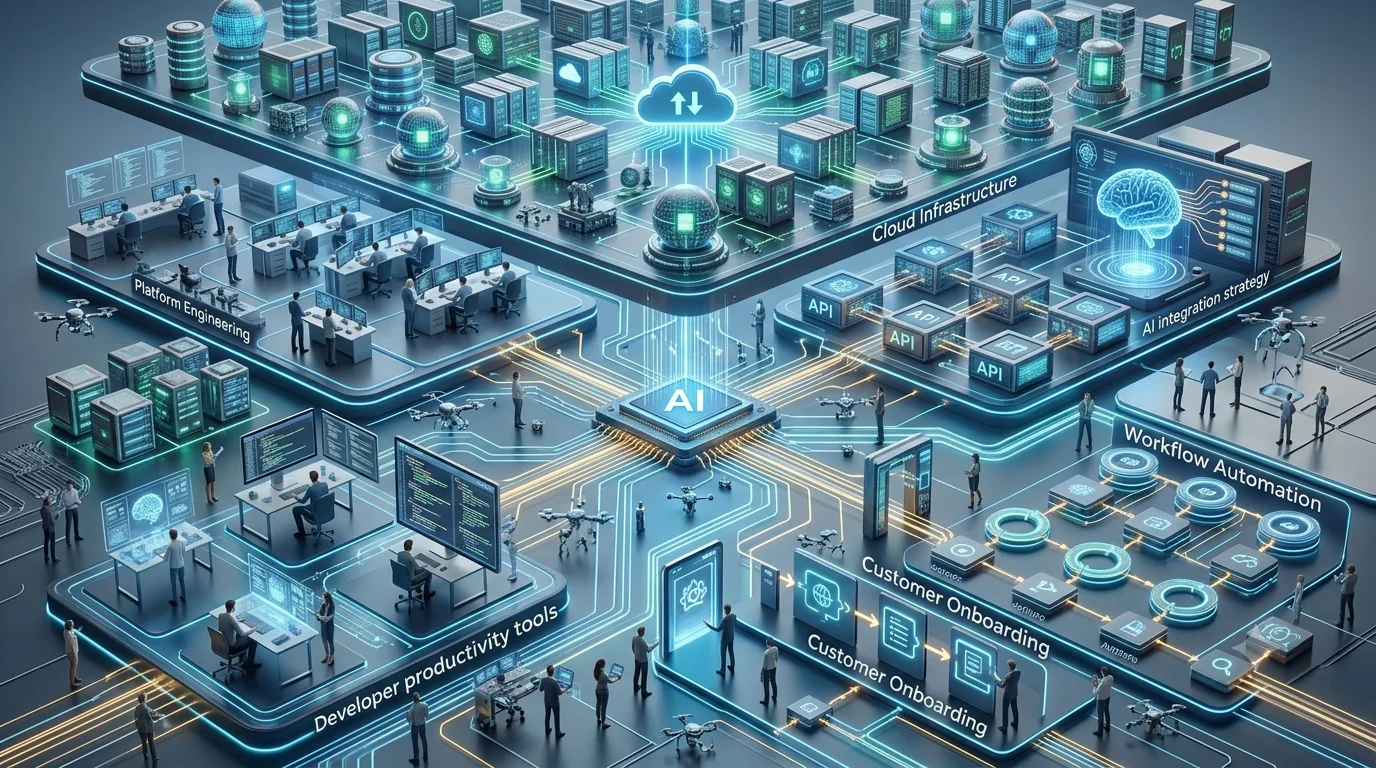
Which AI Developer Tools Should Every Technical Leader Understand?
You don’t need to master every platform, but you should understand the major categories.
1. AI Coding Assistants
These tools help developers write, review, and refactor code more efficiently.
Benefits include:
- Faster development
- Better code quality
- Reduced repetitive work
- Improved onboarding for junior developers
Technical leaders should understand where these tools provide value—and where human review remains essential.
2. Developer Productivity Tools
Developer productivity is no longer measured by lines of code.
Modern productivity focuses on:
- Faster deployments
- Better collaboration
- Reduced context switching
- Improved debugging
- Automated testing
- Knowledge sharing
Helping customers improve developer productivity often leads to stronger product adoption and higher satisfaction.
3. AI Workflow Automation Platforms
Automation has expanded beyond simple task management.
Today’s platforms automate:
- Ticket routing
- Customer onboarding
- Documentation
- Infrastructure provisioning
- Incident response
- Data synchronization
Technical post-sales leaders frequently advise customers on how these automations integrate with existing business processes.
4. Enterprise AI Tools
Enterprise organizations require secure, scalable AI solutions.
Key considerations include:
- Governance
- Security
- Compliance
- Access controls
- Audit logs
- Data privacy
- Model management
Leaders who understand enterprise AI requirements build greater trust with customers.
How Does Developer Experience (DX) Influence Customer Success?
Developer Experience—or DX—has become one of the strongest predictors of long-term customer satisfaction.
If developers enjoy using a platform, they are more likely to:
- Adopt new features
- Build integrations
- Recommend the product internally
- Expand usage across teams
- Renew enterprise contracts
Improving DX isn’t just about writing better documentation.
It includes:
- Better APIs
- Faster onboarding
- Clear implementation guides
- Sample projects
- Interactive documentation
- SDK improvements
- Reliable developer portals
Technical post-sales leaders often become the voice of developers inside the organization, ensuring customer feedback reaches product and engineering teams.
What AI Technical Leadership Skills Separate Great Leaders from Good Ones?
Technical knowledge alone is no longer enough.
The strongest AI leaders combine engineering expertise with strategic thinking, communication, and business awareness.
Some of the most valuable AI technical leadership skills include:
Strategic Thinking
Understanding how AI initiatives align with customer goals rather than focusing solely on technical implementation.
Technical Problem Solving
Breaking down complex implementation challenges into manageable solutions while balancing speed, scalability, and reliability.
Cross-Functional Leadership
Collaborating effectively with product managers, engineering teams, customer success managers, sales, and executive stakeholders to ensure successful outcomes.
Stakeholder Management
Communicating technical concepts in language that both technical and non-technical decision-makers can understand.
Continuous Learning
The AI ecosystem evolves rapidly. Effective leaders stay current with emerging developer platforms, enterprise AI tools, and implementation best practices to provide informed guidance.
What Does Successful AI Implementation Leadership Look Like in 2026?
The best AI implementation leaders don’t focus on deploying software—they focus on helping customers achieve measurable business outcomes.
An implementation is only successful if customers actively use the platform, integrate it into daily workflows, and see lasting value. That’s why AI implementation leadership has become one of the most important technical post-sales leader competencies.
A strong implementation leader balances technical expertise with business strategy, ensuring projects move beyond deployment into long-term adoption.
The AI Implementation Lifecycle
Most enterprise AI projects follow a structured journey:
PhasePrimary GoalKey DeliverablesDiscoveryUnderstand customer objectivesBusiness requirements, success metricsSolution DesignBuild the implementation roadmapArchitecture diagrams, integration planDeploymentConfigure and launchWorking environment, integrationsValidationVerify business outcomesTesting, performance benchmarksAdoptionDrive user engagementTraining, documentation, enablementOptimizationImprove performanceAI workflow automation, reportingExpansionScale across teamsNew use cases, enterprise rollout
Leaders who guide customers through every stage create stronger partnerships and improve customer retention.
How Can Technical Post-Sales Leaders Build an Effective AI Integration Strategy?
A successful AI solution rarely operates on its own.
Instead, it connects with existing business systems, cloud infrastructure, and developer tooling platforms. That’s why a thoughtful AI integration strategy is essential.
Rather than asking, “Can this AI tool work?” ask:
- How will it fit into existing workflows?
- Which APIs are available?
- Will it scale with the business?
- How will data flow between systems?
- What governance policies are required?
Answering these questions early helps avoid expensive rework later.
Common Enterprise Integrations
Modern AI platforms often integrate with:
- CRM systems
- ERP platforms
- Knowledge management tools
- Cloud storage
- Business intelligence platforms
- Identity providers
- Developer platforms
- Customer support software
- Internal APIs
- Data warehouses
The more seamlessly these systems work together, the greater the return on investment.
Why Are API Integrations a Critical Skill?
APIs are the backbone of enterprise software.
Without reliable integrations, even the most advanced AI platform becomes isolated and difficult to scale.
Technical post-sales leaders don’t always write code, but they should understand:
- REST APIs
- Authentication methods
- Webhooks
- Rate limits
- Data synchronization
- Error handling
- Security best practices
This knowledge helps them communicate effectively with engineering teams and guide customers through implementation challenges.
Questions Customers Frequently Ask
Customers often need guidance on practical integration concerns, such as:
- Can we connect this to our existing platform?
- Will data remain secure?
- How long will integration take?
- Do we need custom development?
- Which APIs should we prioritize first?
Leaders who answer these confidently build trust and credibility.
How Does Customer Success Engineering Improve AI Adoption?
Customer Success Engineering bridges the gap between technical implementation and customer outcomes.
Instead of ending the engagement after deployment, customer success engineers ensure users gain ongoing value from the solution.
Key Responsibilities
Customer success engineering teams often:
- Guide onboarding
- Troubleshoot technical issues
- Recommend best practices
- Monitor adoption metrics
- Identify optimization opportunities
- Support expansion initiatives
Their goal is to help customers realize measurable business impact—not just complete a project.
Measuring Success
Leading organizations track metrics such as:
- User adoption rate
- Feature utilization
- Time to first value
- Customer health scores
- Renewal rates
- Expansion revenue
- Support ticket trends
These insights allow post-sales leaders to intervene early and improve customer outcomes.
What Role Does Platform Engineering Play in Enterprise AI?
Platform engineering has become a cornerstone of modern enterprise software delivery.
Rather than building one-off solutions, platform engineering creates standardized environments that enable development teams to work efficiently and consistently.
For technical post-sales leaders, understanding platform engineering helps when advising customers on scalability, reliability, and operational excellence.
Benefits of Platform Engineering
Organizations often experience:
- Faster deployments
- Improved security
- Consistent development environments
- Better resource management
- Easier onboarding
- Reduced operational complexity
These advantages make platform engineering a valuable topic during enterprise AI implementations.
Which Cloud Developer Tools Should Leaders Know?
Cloud-native development is now the default for many organizations.
Technical leaders should understand the purpose of common cloud developer tools, even if they aren’t responsible for day-to-day administration.
Key categories include:
- Cloud infrastructure management
- Container orchestration
- CI/CD pipelines
- Monitoring and observability
- Identity and access management
- Secrets management
- Logging platforms
- Infrastructure as Code (IaC)
Knowing how these tools support AI deployments enables more productive conversations with customer engineering teams.
Why Is Developer Workflow Optimization So Important?
Developers lose valuable time when switching between disconnected tools, waiting for approvals, or repeating manual tasks.
Developer workflow optimization focuses on reducing friction throughout the software development lifecycle.
Common Bottlenecks
Examples include:
- Manual testing
- Repetitive documentation
- Slow deployment approvals
- Poor collaboration
- Complex onboarding
- Inconsistent environments
Addressing these issues improves both developer satisfaction and project delivery speed.
Practical Improvements
Technical post-sales leaders can recommend:
- Automated documentation generation
- AI-assisted code reviews
- Continuous integration pipelines
- Shared development environments
- Automated testing
- Standardized templates
Small workflow improvements often produce significant productivity gains.
How Can AI Workflow Automation Deliver Business Value?
Automation isn’t about replacing people—it’s about eliminating repetitive work so teams can focus on higher-value activities.
AI workflow automation can streamline processes across engineering, customer support, and implementation teams.
Common Automation Opportunities
Organizations often automate:
- Customer onboarding tasks
- Support ticket routing
- Documentation updates
- Deployment notifications
- Incident response workflows
- Usage reporting
- Knowledge base management
- Internal approvals
These automations improve efficiency while reducing the likelihood of human error.
What Does an AI Solution Architect Contribute?
An AI solution architect connects business goals with technical execution.
Rather than focusing on individual features, solution architects design systems that are secure, scalable, and aligned with organizational objectives.
Core Responsibilities
An AI solution architect typically:
- Defines technical architecture
- Evaluates AI technologies
- Plans integrations
- Reviews security requirements
- Supports implementation teams
- Advises stakeholders
- Optimizes performance
Technical post-sales leaders often work closely with solution architects to ensure successful customer implementations.

Which AI Engineering Best Practices Should Every Leader Promote?
The strongest leaders establish repeatable processes instead of relying on individual expertise.
Some widely adopted AI engineering best practices include:
Start with Clear Business Objectives
Every AI initiative should solve a specific business problem.
Avoid implementing AI simply because it’s popular.
Prioritize Data Quality
AI systems depend on accurate, well-managed data.
Poor-quality data leads to unreliable outcomes.
Build Incrementally
Instead of launching large-scale implementations immediately, begin with smaller pilot projects.
This approach allows teams to gather feedback and refine solutions before expanding.
Document Everything
Comprehensive documentation supports:
- Faster onboarding
- Easier troubleshooting
- Better collaboration
- Long-term maintainability
Monitor Performance Continuously
Track:
- System reliability
- Model accuracy
- User adoption
- Operational costs
- Customer satisfaction
Continuous monitoring enables ongoing improvement.
What Common Mistakes Should Technical Post-Sales Leaders Avoid?
Even experienced teams encounter challenges during AI implementations.
Recognizing common pitfalls helps prevent delays and improves customer satisfaction.
Mistake 1: Focusing on Technology Instead of Outcomes
Customers care about business results, not technical features alone.
Always connect technical decisions to measurable value.
Mistake 2: Ignoring Change Management
Successful AI adoption requires training, communication, and stakeholder buy-in.
Without these, even excellent technology may go unused.
Mistake 3: Overcomplicating Implementations
Trying to solve every problem at once increases risk.
Start with achievable goals and expand over time.
Mistake 4: Neglecting Developer Experience
Poor documentation, confusing APIs, and difficult onboarding discourage adoption.
Investing in developer experience (DX) creates long-term benefits.
Mistake 5: Failing to Measure Success
Without clear metrics, it’s impossible to determine whether an implementation has delivered value.
Define success criteria early and review them regularly.
How Can Cross-Functional Leadership Strengthen AI Projects?
AI initiatives rarely succeed in isolation.
Technical post-sales leaders must coordinate efforts across multiple teams, including:
- Engineering
- Product Management
- Customer Success
- Sales
- Security
- Legal
- Executive Leadership
Strong cross-functional leadership ensures everyone shares a common vision, reducing misunderstandings and accelerating decision-making.
Regular communication, transparent progress updates, and clearly defined responsibilities help keep projects on track.
Which Enterprise AI Tools Should Technical Post-Sales Leaders Understand?
The enterprise AI landscape is expanding rapidly, and no single platform fits every organization. Rather than trying to become an expert in every solution, successful technical post-sales leaders understand the strengths, limitations, and ideal use cases of the most common categories of enterprise AI tools.
Their role is to help customers select the right solution based on business goals, technical maturity, security requirements, and long-term scalability.
Enterprise AI Tools Comparison
AI Tool CategoryPrimary PurposeBest ForKey BenefitAI Coding AssistantsCode generation and reviewsSoftware engineering teamsFaster developmentAI Workflow Automation PlatformsAutomate repetitive business processesOperations and customer successImproved efficiencyAI Developer ToolsBuild and test AI-powered applicationsDevelopment teamsIncreased productivityEnterprise AI PlatformsLarge-scale AI deploymentLarge organizationsCentralized AI governanceDeveloper Tooling PlatformsManage developer workflowsEngineering organizationsBetter developer experienceAI Analytics PlatformsInsights and reportingBusiness leadersData-driven decisionsAI Infrastructure PlatformsModel hosting and scalingPlatform engineering teamsReliable performanceKnowledge Management AIIntelligent documentationSupport and onboarding teamsFaster information access
Understanding how these categories complement one another allows technical leaders to recommend complete solutions rather than isolated tools.
Which AI Developer Tools Are Worth Learning First?
You don’t need to master dozens of platforms to become an effective AI leader. Focus on understanding the capabilities that consistently improve developer productivity and customer outcomes.
AI Coding Assistants
Modern AI coding assistants help developers:
- Generate code suggestions
- Explain unfamiliar codebases
- Refactor existing applications
- Detect common errors
- Write unit tests
- Create documentation
While these tools significantly improve productivity, human oversight remains essential for quality, security, and compliance.
Documentation Assistants
Maintaining technical documentation is time-consuming.
AI-powered documentation tools can:
- Draft API documentation
- Summarize release notes
- Generate onboarding guides
- Organize knowledge bases
- Update implementation instructions
This allows technical teams to spend more time solving customer problems.
AI Testing Tools
Testing automation continues to improve through AI.
These platforms assist with:
- Test generation
- Regression testing
- Bug detection
- Performance monitoring
- Quality assurance
Technical post-sales leaders benefit from understanding how automated testing supports reliable software implementations.
How Do Developer Productivity Tools Improve Customer Success?
Developer productivity is directly connected to customer satisfaction.
When engineering teams can build, deploy, and troubleshoot efficiently, customers receive:
- Faster implementations
- Quicker issue resolution
- More frequent feature updates
- Improved reliability
- Better documentation
Characteristics of High-Performing Developer Platforms
Successful organizations invest in platforms that provide:
- Unified developer workflows
- Integrated documentation
- Automation capabilities
- Collaboration features
- Monitoring dashboards
- API management
- Secure deployment pipelines
These capabilities reduce operational friction while improving overall developer experience (DX).
Why Is Technical Consulting Becoming More Strategic?
Today’s customers expect advisors—not just implementers.
Technical consulting AI has shifted from answering technical questions to helping organizations make strategic technology decisions.
Modern Technical Consultants Help Customers:
- Evaluate AI readiness
- Identify automation opportunities
- Reduce implementation risks
- Optimize workflows
- Improve developer productivity
- Plan future AI initiatives
Rather than simply explaining features, consultants guide customers toward achieving measurable business outcomes.
How Can Customer Onboarding AI Improve the Implementation Experience?
Customer onboarding often determines whether a project succeeds or struggles.
AI-powered onboarding streamlines repetitive tasks while creating a more personalized experience.
AI Can Assist With:
- Personalized implementation checklists
- Intelligent documentation recommendations
- Automated training plans
- Progress tracking
- Interactive knowledge assistants
- Resource recommendations
These improvements reduce time-to-value and help customers become productive more quickly.
Best Practices for Customer Onboarding
Successful onboarding programs usually include:
- Clear implementation milestones
- Defined success metrics
- Technical enablement sessions
- Role-based training
- Regular progress reviews
- Adoption monitoring
- Executive business reviews
Strong onboarding lays the foundation for long-term customer success.
What Makes SaaS Implementations Successful?
SaaS implementation involves much more than activating user accounts.
Successful implementations require alignment between technology, people, and business objectives.
Essential Components
Technical post-sales leaders should ensure every implementation includes:
- Discovery workshops
- Business requirement validation
- Integration planning
- Security reviews
- User training
- Documentation
- Go-live support
- Success measurement
Skipping any of these stages often creates avoidable challenges later.
How Does AI Infrastructure Support Enterprise Growth?
AI infrastructure provides the foundation for reliable AI-powered applications.
Without scalable infrastructure, organizations may experience:
- Performance issues
- Downtime
- Security concerns
- Slow deployments
- Limited scalability
Core AI Infrastructure Components
Enterprise AI infrastructure typically includes:
- Compute resources
- Storage systems
- Networking
- Monitoring platforms
- Security controls
- Identity management
- Model hosting environments
- Data pipelines
Technical post-sales leaders don’t necessarily manage infrastructure directly, but understanding these components enables more productive customer conversations.
Why Are Enterprise Developer Tools Critical for Scaling?
As organizations grow, development processes become increasingly complex.
Enterprise developer tools provide standardized workflows that improve collaboration, governance, and software quality.
Common Enterprise Developer Tools Support
- Source control
- Continuous integration
- Continuous delivery
- Artifact management
- Security scanning
- Dependency management
- Documentation
- Performance monitoring
Standardization reduces operational risk while improving consistency across teams.
How Can Technical Enablement Improve Product Adoption?
Technical enablement equips customers with the knowledge and confidence to use a platform effectively.
Rather than delivering one-time training sessions, successful enablement programs provide ongoing learning opportunities.
Effective Enablement Includes
- Live workshops
- Hands-on labs
- Technical documentation
- Video tutorials
- Certification paths
- Community forums
- Office hours
- Implementation playbooks
Customers who receive continuous enablement are more likely to expand platform usage and recommend the product internally.
What Does Strong Stakeholder Management Look Like?
Enterprise implementations involve many stakeholders with different priorities.
Technical post-sales leaders must communicate effectively with:
- Developers
- Engineering managers
- Product leaders
- Security teams
- Procurement
- Executive sponsors
- Customer success managers
- Business users
Each audience requires a different communication style.
For example:
- Developers want technical depth.
- Executives want business outcomes.
- Project managers want timelines.
- Security teams want compliance details.
Adjusting communication for each group improves alignment and reduces misunderstandings.
Real-World Example: AI-Powered Customer Implementation
Imagine a global software company deploying an AI-powered developer platform to a large enterprise customer.
Instead of manually managing every onboarding task, the technical post-sales team introduces:
- AI-generated implementation checklists
- Automated documentation updates
- Intelligent ticket routing
- API integration templates
- Self-service knowledge assistants
- Usage analytics dashboards
Within a few months, the customer reports:
- Faster onboarding for new developers
- Reduced support requests
- Higher feature adoption
- Improved deployment consistency
- Better collaboration between engineering teams
The success wasn’t driven by AI alone—it came from combining technology with strong leadership, planning, and customer engagement.
What Emerging Trends Will Shape Technical Post-Sales Leadership Beyond 2026?
The role of technical post-sales leaders will continue evolving as AI becomes more deeply integrated into enterprise software.
Several trends are already influencing hiring priorities and customer expectations.
AI-Augmented Customer Success
AI will assist customer success teams by identifying adoption risks, recommending next-best actions, and surfacing proactive insights before issues escalate.
Intelligent Developer Platforms
Developer platforms will increasingly include built-in AI assistants for documentation, debugging, testing, and code optimization.
Predictive Implementations
Implementation teams will use AI to forecast project risks, estimate timelines, and recommend corrective actions before delays occur.
Autonomous Workflow Automation
Routine operational tasks—from onboarding to reporting—will become increasingly automated, allowing teams to focus on strategic consulting.
Greater Focus on Responsible AI
Organizations will place greater emphasis on governance, transparency, security, privacy, and ethical AI practices.
Technical post-sales leaders who understand these principles will become trusted advisors rather than implementation specialists.
Key Takeaways
The most successful technical post-sales leaders in 2026 combine technical expertise with strategic thinking, customer empathy, and AI-driven innovation. By mastering AI developer tooling leadership, developer productivity tools, AI workflow automation, customer success engineering, AI integration strategy, and enterprise AI tools, leaders can guide customers through successful implementations and build long-term partnerships.
These competencies not only improve project outcomes but also strengthen product adoption, customer retention, and business growth.
Frequently Asked Questions (FAQ)
What are the most important technical post-sales leader competencies in 2026?
The most valuable technical post-sales leader competencies combine technical expertise with leadership and business strategy. Leaders should understand AI developer tools, customer success engineering, AI implementation leadership, developer tooling platforms, stakeholder management, API integrations, developer experience (DX), and AI workflow automation. These skills help teams deliver successful implementations while driving long-term customer adoption and retention.
Do technical post-sales leaders need programming experience?
Programming experience is helpful, but it isn’t always required.
What matters most is the ability to understand software architecture, APIs, cloud platforms, integration strategies, and developer workflows. Leaders who can communicate effectively with engineering teams and translate technical concepts into business outcomes are highly valuable, even if they aren’t writing production code every day.
Which AI developer tools should technical post-sales leaders learn first?
Start with the categories that have the biggest impact on enterprise implementations:
- AI coding assistants
- Developer productivity tools
- AI workflow automation platforms
- API testing tools
- Documentation automation platforms
- Knowledge management systems
- Monitoring and observability tools
- Cloud developer tools
Rather than mastering every product, focus on understanding how these tools solve customer problems and improve implementation outcomes.
How can AI improve customer success engineering?
AI helps customer success engineering teams become more proactive instead of reactive.
Common applications include:
- Predicting customer health scores
- Identifying adoption risks
- Automating onboarding tasks
- Generating implementation documentation
- Routing support tickets intelligently
- Recommending product features based on customer usage
- Providing AI-powered knowledge assistants
These capabilities allow teams to spend more time delivering strategic value and less time on repetitive operational work.
What role does developer experience (DX) play in customer satisfaction?
Developer experience (DX) has a direct influence on product adoption.
When developers have access to intuitive documentation, reliable APIs, automation, and efficient workflows, they can build and deploy solutions faster. A positive developer experience reduces onboarding time, lowers support requests, and encourages long-term product usage across engineering teams.
How can organizations measure the success of AI implementations?
Successful AI implementations should be evaluated using both technical and business metrics.
Common success indicators include:
- Time to first value
- Product adoption rate
- User engagement
- Deployment speed
- Workflow automation improvements
- Customer satisfaction scores
- Renewal and expansion rates
- Reduction in manual processes
- Return on investment (ROI)
Tracking these metrics helps organizations identify opportunities for continuous improvement.
What industries benefit the most from AI implementation leadership?
Nearly every industry is investing in AI, but adoption is especially strong in:
- Enterprise SaaS
- Financial services
- Healthcare
- Manufacturing
- Retail and eCommerce
- Telecommunications
- Cybersecurity
- Logistics
- Education technology
- Government technology
Technical post-sales leaders help these organizations implement AI responsibly while aligning technology with business goals.
How should technical post-sales leaders prepare for the future of AI?
The AI landscape changes quickly, so continuous learning is essential.
Focus on developing expertise in:
- AI integration strategy
- Enterprise AI governance
- Platform engineering
- Cloud-native development
- AI engineering best practices
- Responsible AI
- Developer productivity
- Cross-functional leadership
- Business consulting
- Change management
Leaders who combine technical depth with strategic thinking will be well positioned for future enterprise AI initiatives.
Final Checklist: Are You Ready to Lead AI-Driven Post-Sales Teams?
Use this checklist to assess your current capabilities and identify areas for growth.
Leadership Skills
- ✔ Communicate technical concepts clearly to both technical and non-technical audiences.
- ✔ Align AI initiatives with customer business goals.
- ✔ Lead cross-functional implementation teams.
- ✔ Build trust with executive stakeholders.
Technical Skills
- ✔ Understand AI developer tools and developer tooling platforms.
- ✔ Design scalable AI integration strategies.
- ✔ Work confidently with APIs and cloud developer tools.
- ✔ Promote AI engineering best practices and platform engineering principles.
Customer Success Skills
- ✔ Create structured onboarding plans.
- ✔ Monitor adoption and customer health metrics.
- ✔ Deliver continuous technical enablement.
- ✔ Recommend workflow optimizations based on customer feedback.
Strategic Skills
- ✔ Evaluate enterprise AI tools for scalability and security.
- ✔ Identify automation opportunities that deliver measurable ROI.
- ✔ Balance innovation with governance and compliance.
- ✔ Drive long-term customer success rather than short-term implementation wins.
If you can confidently check most of these items, you’re on the right path toward becoming an AI-ready technical post-sales leader.
Conclusion
The role of the technical post-sales leader has evolved dramatically. In 2026, success depends on much more than technical troubleshooting or software implementation. Organizations are looking for leaders who can bridge the gap between engineering, customer success, and business strategy while helping customers adopt AI with confidence.
Mastering technical post-sales leader competencies, AI developer tooling leadership, developer tooling AI competencies, AI implementation leadership, developer productivity tools, and AI integration strategy allows leaders to create lasting value for customers. Instead of simply delivering projects, they become trusted advisors who guide organizations through digital transformation and continuous innovation.
As enterprise AI adoption accelerates, the demand for professionals who understand technical post-sales AI, customer success engineering, AI solution architecture, platform engineering, and AI workflow automation will continue to grow. The leaders who invest in these capabilities today will be better equipped to solve complex challenges, strengthen customer relationships, and drive sustainable business growth tomorrow.
Whether you’re managing a customer success engineering team, supporting enterprise software implementations, or leading developer experience initiatives, now is the ideal time to build these future-ready skills. Continuous learning, practical experience, and a customer-first mindset will help you stay ahead in an AI-powered world.
Is Perplexity AI Brand Mention Monitoring Tool Worth It? (2026 Honest Review)
Is Droven IO AI Automation Tools Worth It? (2026 Review)
What Are the Best AI Tools for Business Workflow Analysis Process Mapping 2026?