

If you’re launching or growing a startup in 2026, you’ve probably realized one thing already: working harder isn’t enough anymore. The startups gaining traction today are the ones using smart automation, AI-driven insights, and integrated business software to save time and make better decisions.
I’ve spent years testing SaaS platforms, AI productivity tools, and startup automation software for businesses of different sizes. One lesson stands out—choosing the right platform early can eliminate countless manual tasks and help founders focus on growth instead of operations. That’s why I decided to take a closer look at Growth Navigate Startup Tools, a platform that’s attracting attention among entrepreneurs looking to streamline everything from customer acquisition to workflow automation.
Whether you’re researching your first AI business platform or comparing it with established competitors, this guide covers everything you need to know.
What Are Growth Navigate Startup Tools?
Quick Answer: Growth Navigate Startup Tools is an AI-powered startup management platform designed to help entrepreneurs organize, automate, and scale their businesses from one central dashboard. Instead of juggling multiple apps, users can manage workflows, marketing, customer relationships, and business operations more efficiently.
Modern startups often rely on dozens of software solutions. One tool handles email marketing, another manages projects, another tracks leads, while yet another generates reports.
That approach works—but it quickly becomes expensive, fragmented, and difficult to manage.
Growth Navigate Startup Tools aims to solve this challenge by bringing together several essential startup functions under one platform.
Depending on your business needs, the platform may help with:
- Business workflow automation
- Customer acquisition tracking
- AI-powered productivity
- Startup project management
- Marketing coordination
- Sales pipeline organization
- Team collaboration
- Performance analytics
- Business planning
- Growth monitoring
For founders who want fewer subscriptions and less manual work, this integrated approach can be appealing.
Why Are Growth Navigate Startup Tools Becoming Popular in 2026?
Quick Answer: The growing popularity of AI startup tools is driven by one major trend: founders need to accomplish more with smaller teams. Automation, intelligent reporting, and centralized management have become essential rather than optional.
The startup ecosystem has changed dramatically over the past few years.
Instead of hiring large operational teams from day one, many startups now rely on AI business solutions to automate repetitive work.
Several factors are driving this shift:
Rising Software Costs
Many startups pay separately for:
- CRM software
- Marketing automation
- Analytics
- Team collaboration
- Customer support
- Task management
- Reporting tools
These subscriptions quickly add up.
Business owners are increasingly looking for platforms that combine multiple functions into one ecosystem.

AI Is Saving Valuable Time
Artificial intelligence has evolved beyond simple chatbots.
Today’s AI startup tools can:
- Summarize meetings
- Generate reports
- Analyze business performance
- Recommend workflow improvements
- Assist with customer communication
- Organize large datasets
- Identify growth opportunities
This allows entrepreneurs to focus on strategy rather than repetitive administrative work.
Better Visibility Across the Business
One common challenge for startups is scattered information.
Marketing data lives in one app.
Sales data lives in another.
Project updates live somewhere else.
Growth Navigate Startup Tools attempts to centralize these insights, giving founders a clearer picture of what’s happening across the business.
Who Should Consider Using Growth Navigate Startup Tools?
Quick Answer: Growth Navigate Startup Tools is best suited for entrepreneurs, startups, small businesses, freelancers managing teams, and growing companies looking to automate repetitive tasks and improve operational efficiency.
Not every business needs an advanced startup platform.
However, certain users may benefit significantly.
Startup Founders
Early-stage startups often operate with limited budgets.
Instead of hiring additional staff immediately, founders can automate routine processes while maintaining productivity.
Small Business Owners
Growing businesses frequently reach a stage where spreadsheets and manual processes become inefficient.
A centralized business automation platform can simplify operations and reduce errors.
Marketing Teams
Marketing professionals often juggle:
- Campaign tracking
- Lead management
- Reporting
- Content planning
- Performance monitoring
Having these activities connected within one platform can improve coordination.
Sales Teams
Sales automation software helps representatives spend less time updating records and more time building customer relationships.
Automation can assist with:
- Lead organization
- Pipeline updates
- Follow-up reminders
- Performance dashboards
Agencies
Digital agencies managing multiple clients may appreciate workflow automation and centralized reporting that reduces repetitive administrative work.
What Are the Main Growth Navigate Startup Tools Features?
Quick Answer: The platform focuses on combining AI-powered automation, startup management, analytics, collaboration, and productivity features into one workspace.
Let’s examine the core capabilities in more detail.
AI Workflow Automation
Automation is one of the platform’s biggest selling points.
Rather than manually repeating routine tasks, users can build automated workflows for common business activities.
Examples include:
- Assigning new leads
- Updating project status
- Sending follow-up emails
- Creating reminders
- Organizing customer information
- Triggering notifications
Reducing repetitive work allows teams to concentrate on higher-value activities.
Business Dashboard
Instead of opening multiple applications every morning, users can access key business metrics from one dashboard.
Depending on configuration, dashboards may include:
- Revenue tracking
- Sales progress
- Marketing performance
- Team activity
- Project status
- Customer engagement
Centralized reporting makes it easier to identify trends and respond quickly.
Startup Project Management
Managing startup projects involves balancing priorities, deadlines, and limited resources.
The platform may include tools for:
- Task assignments
- Deadline management
- Team collaboration
- Progress tracking
- Priority organization
- Milestone planning
This helps founders keep projects moving without relying on multiple disconnected applications.
Customer Relationship Management (CRM)
Customer relationships remain one of the most valuable assets for any startup.
Integrated CRM functionality may allow businesses to:
- Store customer information
- Track conversations
- Manage sales opportunities
- Record interactions
- Monitor customer journeys
Having customer data available alongside operational workflows improves visibility across the organization.
Analytics and Reporting
Business decisions become stronger when supported by reliable data.
Reporting capabilities may help users understand:
- Customer growth
- Conversion performance
- Revenue trends
- Marketing ROI
- Team productivity
- Operational efficiency
Visual dashboards make large amounts of information easier to interpret.
Team Collaboration
As startups grow, communication often becomes more complex.
Collaboration features may include:
- Shared workspaces
- Team comments
- Task updates
- File sharing
- Notifications
- Activity logs
These capabilities reduce communication gaps and improve project coordination.
AI Productivity Assistance
Many AI startup tools now include intelligent assistants.
These assistants can potentially help users:
- Summarize reports
- Draft business content
- Organize information
- Generate insights
- Suggest workflow improvements
- Answer internal questions
Rather than replacing employees, these tools aim to improve productivity.
How Does Growth Navigate Startup Tools Use AI?
Quick Answer: Growth Navigate Startup Tools incorporates AI to reduce repetitive work, surface business insights, and assist with decision-making rather than replacing human expertise.
Artificial intelligence is becoming a standard feature across business software.
The real value lies in how effectively it’s implemented.
Possible AI-powered capabilities include:
Intelligent Recommendations
Instead of manually analyzing every business metric, AI can highlight trends that deserve attention.
Examples include:
- Declining conversion rates
- Increasing customer engagement
- Workflow bottlenecks
- Sales opportunities
Predictive Insights
Some AI business solutions attempt to forecast future outcomes based on historical data.
This can help startups prepare for:
- Seasonal demand
- Resource allocation
- Sales forecasting
- Customer behavior
Automated Content Assistance
Many startup marketing tools now generate:
- Email drafts
- Marketing copy
- Internal documentation
- Business summaries
- Customer responses
This saves time while still allowing teams to edit and personalize content.
Smarter Workflow Suggestions
Instead of manually designing every automation, AI may recommend:
- More efficient processes
- Redundant task removal
- Improved team workflows
- Better project organization
These recommendations become increasingly valuable as businesses scale.

What Are the Growth Navigate Startup Tools Pricing Options?
Quick Answer: Growth Navigate Startup Tools pricing may vary depending on subscription level, team size, and available features. Businesses should always review the latest pricing details before subscribing, as plans can change over time.
When evaluating any SaaS platform, price is only one part of the equation. The real question is whether the software delivers enough value to justify its ongoing cost.
Although exact plan names and feature limits may evolve, startup software typically follows a tiered pricing model.
PlanBest ForTypical FeaturesStarterSolo foundersCore automation, limited AI tools, basic dashboardsProfessionalGrowing startupsExpanded automation, analytics, CRM, collaborationBusinessSmall teamsAdvanced reporting, workflow management, integrationsEnterpriseLarger organizationsCustom solutions, premium support, advanced security
When comparing Growth Navigate Startup Tools pricing, consider more than the monthly subscription.
Ask yourself:
- Does it replace several other software subscriptions?
- Will automation save hours each week?
- Can it reduce operational costs?
- Will it improve team productivity?
- Does it support future business growth?
For many startups, consolidating multiple tools into one platform can offset the subscription cost over time
What Is the Real-World Experience of Using Growth Navigate Startup Tools?
Quick Answer: Growth Navigate Startup Tools offers a modern, centralized workspace designed to reduce the complexity of running a startup. While no platform is perfect, its biggest strengths are automation, AI-assisted workflows, and bringing multiple business functions together in one place.
After exploring the platform’s capabilities and comparing them with what startups typically need in 2026, it’s clear that Growth Navigate Startup Tools focuses on solving a common problem: founders often spend too much time managing software instead of growing their business.
The platform isn’t trying to replace every specialized application on the market. Instead, it aims to eliminate the need for several separate tools by combining essential startup functions into one ecosystem.
If your team currently switches between multiple dashboards every day, you’ll likely appreciate having a more unified workflow.
What Are the Biggest Advantages of Growth Navigate Startup Tools?
Quick Answer: The platform stands out for its AI-powered automation, centralized dashboard, workflow management, and productivity-focused design. It can help startups save time while improving visibility across different areas of the business.
Here are the biggest strengths.
1. Everything Is Organized in One Place
One of the first things you’ll notice is the emphasis on centralization.
Instead of logging into separate apps for:
- Customer management
- Project tracking
- Team collaboration
- Analytics
- Workflow automation
you can manage many of these activities from a single dashboard.
For growing startups, this reduces confusion and helps teams stay aligned.
2. AI Reduces Manual Work
One reason Growth Navigate Startup Tools AI is gaining attention is its focus on eliminating repetitive tasks.
Instead of spending hours updating spreadsheets or assigning recurring tasks manually, automation can handle much of that work in the background.
Potential examples include:
- Auto-assigning leads
- Scheduling reminders
- Updating project statuses
- Triggering notifications
- Organizing workflows
Saving even a few hours each week can have a meaningful impact for small teams.
3. Designed With Startup Growth in Mind
Unlike enterprise software built for large corporations, Growth Navigate Startup Tools is positioned toward businesses that need flexibility.
Startups often experience rapid changes.
New employees join.
Marketing campaigns launch.
Sales processes evolve.
Having software that adapts quickly is a major advantage.
4. Better Business Visibility
Many founders struggle to answer simple questions such as:
- Which marketing channel performs best?
- Which sales stage loses the most leads?
- Which projects are behind schedule?
- Which teams are overloaded?
A centralized analytics dashboard makes these answers easier to find.
Better visibility usually leads to better decision-making.
5. Automation Helps Teams Scale
Hiring additional employees isn’t always the first solution.
Automation allows startups to handle increasing workloads without immediately expanding headcount.
Examples include:
- Customer onboarding
- Internal approvals
- Lead routing
- Status updates
- Report generation
This makes Growth Navigate Startup Tools particularly appealing for startups entering their scaling phase.
Are There Any Downsides to Growth Navigate Startup Tools?
Quick Answer: Like any startup software, Growth Navigate Startup Tools has limitations. The right choice depends on your company’s size, workflows, and existing software stack.
Here are a few considerations before subscribing.
Learning Curve
Modern business software often includes many features.
Although centralization is beneficial, new users may need time to learn:
- Dashboard navigation
- Workflow creation
- Automation setup
- Team permissions
- Reporting tools
Most teams become comfortable after spending some time exploring the platform.
Not Every Business Needs Every Feature
Solo freelancers with very simple workflows may not use every available capability.
Businesses should evaluate whether they actually need:
- CRM functionality
- Advanced automation
- Team collaboration
- AI reporting
Choosing software that matches your operational complexity is always the smartest approach.
Integrations May Matter
Many startups already use tools like:
- Accounting software
- Communication platforms
- Marketing systems
- Customer support applications
Before adopting any new business platform, confirm that it integrates smoothly with the software your team already relies on.
Subscription Costs Can Add Up
Although consolidation may reduce overall software expenses, businesses should still compare pricing against their current software stack.
Sometimes one integrated platform saves money.
Other times, a combination of specialized tools may offer better value.
The answer depends on your team’s specific needs.
Growth Navigate Startup Tools Pros and Cons
Here’s a quick overview.
ProsConsCentralized business dashboardLearning curve for new usersAI-powered workflow automationSome advanced features may exceed the needs of solo foundersStartup-focused designIntegration availability should be verifiedImproved team collaborationPricing depends on business requirementsHelpful analytics and reportingInitial workflow setup takes timeCan replace multiple software subscriptionsBest value often comes with team adoption
Overall, the advantages are likely to outweigh the drawbacks for startups that need better organization and automation.
How Does Growth Navigate Startup Tools Compare With Other Startup Growth Tools?
Quick Answer: Growth Navigate Startup Tools competes by offering an all-in-one startup platform rather than focusing on just one business function. That makes it attractive for founders who prefer simplicity over managing multiple subscriptions.
Here’s a high-level comparison.
FeatureGrowth Navigate Startup ToolsTypical Single-Purpose SoftwareAI automation✔Often limitedCRM✔Separate subscriptionWorkflow automation✔Usually separateAnalytics✔Separate platformTeam collaboration✔Separate applicationStartup management✔Usually requires multiple toolsBusiness dashboard✔Fragmented across apps
If your startup already has a carefully optimized software stack, switching may not make sense immediately.
However, founders starting from scratch often appreciate having fewer systems to manage.
How Can Entrepreneurs Use Growth Navigate Startup Tools Effectively?
Quick Answer: The best results come from implementing the platform gradually. Start with one business process, automate repetitive tasks, and expand your workflows as your team becomes comfortable.
Trying to automate everything on day one often creates unnecessary complexity.
Instead, follow a structured approach.
Step 1: Define Your Goals
Ask yourself:
- Do you want more leads?
- Better organization?
- Faster project delivery?
- Improved customer retention?
- Better reporting?
Clear objectives make software implementation much easier.
Step 2: Organize Existing Processes
Before creating automation, map your current workflow.
Identify:
- Repetitive tasks
- Manual approvals
- Communication bottlenecks
- Duplicate work
Automation is most effective when built on well-defined processes.
Step 3: Start With Simple Automation
Begin with smaller workflows.
Examples include:
- Assign new leads automatically.
- Send reminder notifications.
- Update project stages.
- Schedule recurring reports.
Once these are running smoothly, you can build more advanced automations.
Step 4: Train Your Team
Even excellent software fails without user adoption.
Spend time helping team members understand:
- Dashboard navigation
- Workflow management
- AI features
- Reporting tools
- Collaboration features
Small investments in training often deliver long-term productivity gains.
Step 5: Review Analytics Regularly
Business dashboards are valuable only if they’re actually used.
Review reports weekly to monitor:
- Sales performance
- Marketing effectiveness
- Customer acquisition
- Team productivity
- Operational bottlenecks
Continuous improvement is one of the biggest benefits of modern startup management platforms.
Which Types of Businesses Benefit Most?
Quick Answer: Growth Navigate Startup Tools is most beneficial for organizations experiencing growth, managing multiple workflows, or looking to reduce manual work through automation.
It may be especially valuable for:
Technology Startups
Fast-moving software companies often need scalable systems from the beginning.
Marketing Agencies
Agencies managing multiple clients can benefit from centralized reporting and workflow management.
E-commerce Businesses
Automation can improve:
- Order workflows
- Customer communication
- Marketing coordination
- Sales reporting
Consulting Firms
Professional service businesses often juggle multiple clients simultaneously.
Project management and CRM integration can simplify day-to-day operations.
Small Businesses Preparing to Scale
Businesses moving beyond spreadsheets usually benefit from structured workflow management and automation.
What Are Some Best Practices for Getting the Most Value?
Quick Answer: Success depends less on the software itself and more on how thoughtfully it’s implemented. A clear strategy, consistent team adoption, and regular optimization will help you maximize its value.
Keep these best practices in mind:
- Avoid over-automating. Not every task needs AI or automation. Focus on repetitive, time-consuming processes first.
- Review workflows regularly. As your startup grows, update automations to match new goals and team structures.
- Keep your data clean. Accurate customer and project data lead to better reports and AI recommendations.
- Measure results. Track key metrics such as time saved, lead response time, project completion rates, and customer satisfaction.
- Gather team feedback. Encourage employees to share what’s working and what isn’t. Small improvements can significantly boost productivity.
By treating Growth Navigate Startup Tools as an evolving business system rather than a one-time setup, startups are more likely to see long-term benefits.
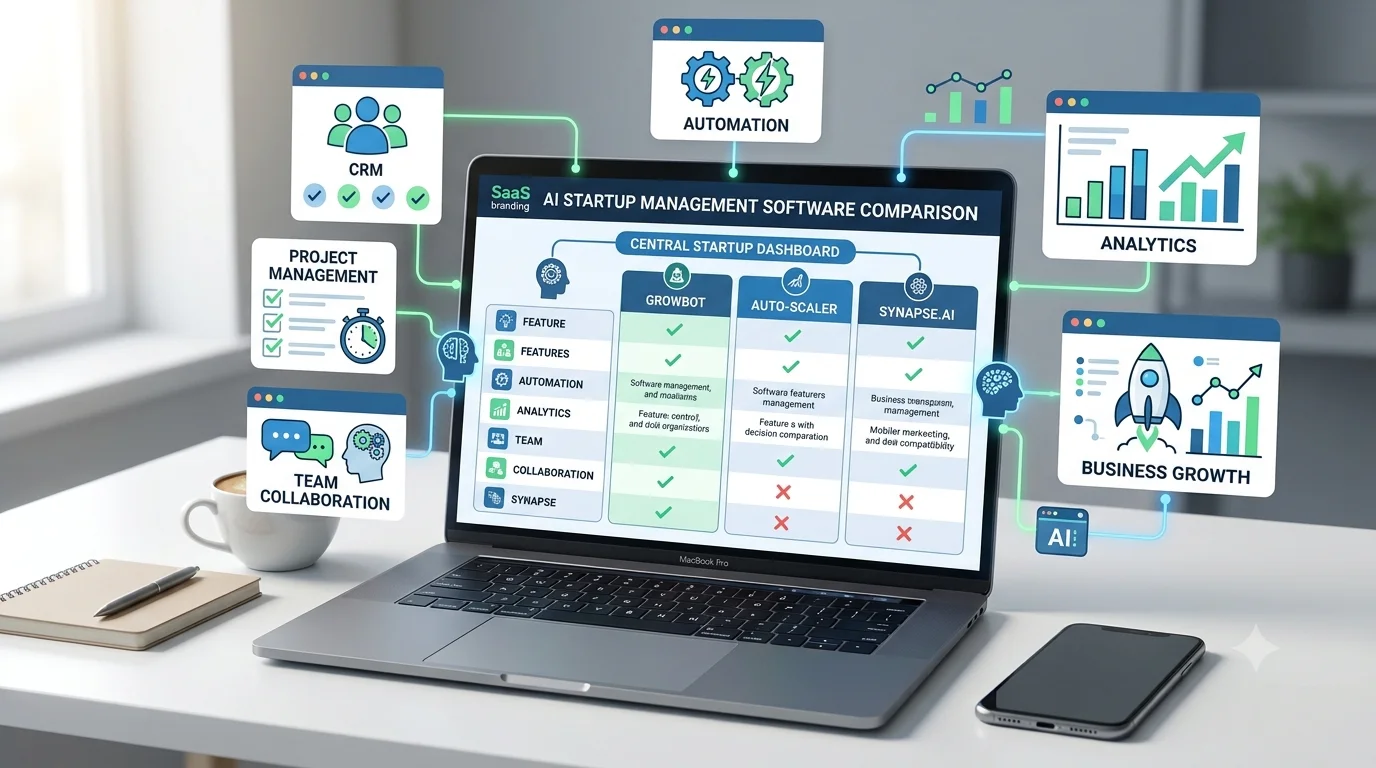
What Are the Best Growth Navigate Startup Tools Alternatives in 2026?
Quick Answer: Growth Navigate Startup Tools offers a broad all-in-one solution, but it isn’t the only option available. Depending on your budget, team size, and business goals, several other AI startup tools and business growth software platforms may be a better fit.
Here are some of the most popular alternatives in 2026.
PlatformBest ForKey StrengthPotential DrawbackHubSpotCRM & MarketingExcellent CRM and automationPremium plans can become expensiveClickUpProject ManagementHighly customizable workflowsTakes time to masterMonday.comTeam CollaborationEasy-to-use visual interfaceAdvanced automation requires higher-tier plansNotion AIDocumentation & Knowledge ManagementAI-powered notes and organizationLimited CRM functionalityZoho OneSmall BusinessesLarge suite of business appsInterface may feel overwhelming for beginnersAirtableWorkflow ManagementFlexible database and automationAdvanced features have a learning curve
If your startup already relies heavily on one of these platforms, compare integration options before switching. In many cases, improving your existing workflow may provide better value than migrating to a completely new system.
How Does Growth Navigate Startup Tools Compare With AI Startup Tools?
Quick Answer: Growth Navigate Startup Tools focuses on combining AI automation, startup management, and productivity into one workspace, while many competitors specialize in a single business function.
Here’s a broader comparison.
FeatureGrowth Navigate Startup ToolsTraditional Startup SoftwareAI Assistance✔ Built-inOften limited or separateWorkflow Automation✔Usually requires additional softwareCRM✔Frequently sold separatelyStartup Management✔Multiple tools requiredBusiness Analytics✔Often fragmentedCollaboration✔Separate applicationsScalabilityHighDepends on software stack
For startups aiming to reduce software complexity, an integrated platform can simplify daily operations and lower administrative overhead.
Is Growth Navigate Startup Tools Worth It in 2026?
Quick Answer: For startups seeking AI-powered automation, centralized management, and scalable workflows, Growth Navigate Startup Tools is worth considering in 2026. The final decision should depend on your business size, operational needs, and existing software ecosystem.
No platform is universally perfect.
However, Growth Navigate Startup Tools addresses several common challenges that startups face:
- Too many disconnected software subscriptions
- Manual administrative work
- Limited visibility across teams
- Inefficient collaboration
- Difficulty scaling operations
If these issues sound familiar, the platform could deliver meaningful value by streamlining processes and improving productivity.
On the other hand, if you’re a solo entrepreneur with very simple workflows, you may find that lighter, more affordable tools meet your needs just as well.
The key is to choose software that matches your current stage of growth while leaving room to expand as your business evolves.
Is Droven IO AI Automation Tools Worth It? (2026 Review)
Frequently Asked Questions (FAQ)
What is Growth Navigate Startup Tools?
Growth Navigate Startup Tools is an AI-powered startup management platform designed to help businesses automate workflows, organize operations, manage customer relationships, and improve productivity from a centralized dashboard.
Is Growth Navigate Startup Tools worth it for small businesses?
Yes, it can be a strong option for small businesses that want to reduce manual work, improve organization, and replace multiple software subscriptions with one integrated platform.
What features does Growth Navigate Startup Tools include?
Depending on the subscription plan, features may include:
- AI workflow automation
- CRM capabilities
- Business analytics
- Team collaboration
- Project management
- Sales tracking
- Marketing coordination
- Reporting dashboards
How much does Growth Navigate Startup Tools cost?
Growth Navigate Startup Tools pricing depends on the selected plan, team size, and available features. Businesses should review the latest pricing on the official website, as subscription plans may change over time.
Can startups automate daily tasks with Growth Navigate Startup Tools?
Yes. One of the platform’s primary goals is helping startups automate repetitive tasks such as lead assignment, notifications, reporting, workflow management, and project updates.
What are the best Growth Navigate Startup Tools alternatives?
Popular alternatives include:
- HubSpot
- ClickUp
- Monday.com
- Zoho One
- Airtable
- Notion AI
The best choice depends on your budget, team size, and workflow requirements.
Does Growth Navigate Startup Tools use artificial intelligence?
Yes. The platform incorporates AI to assist with workflow automation, productivity improvements, business insights, reporting, and operational efficiency.
Who should use Growth Navigate Startup Tools?
The platform is best suited for:
- Startup founders
- Entrepreneurs
- Small businesses
- Marketing teams
- Sales teams
- Growing agencies
- Companies looking to automate business operations
Final Verdict
Startups in 2026 face increasing pressure to move faster, operate leaner, and make smarter decisions with limited resources. AI is no longer a competitive advantage—it’s becoming a standard part of running a modern business.
Growth Navigate Startup Tools positions itself as a practical solution for entrepreneurs who want to centralize operations, automate repetitive work, and gain better visibility into their business without juggling multiple disconnected applications.
Its strengths lie in workflow automation, collaboration, analytics, and AI-assisted productivity. While there is a learning curve and businesses should carefully evaluate pricing and integrations, the platform has the potential to replace several standalone tools, simplify daily operations, and support long-term growth.
If your startup is spending more time managing software than serving customers or building products, adopting an integrated business growth platform could be a worthwhile investment.
Ultimately, the right software isn’t the one with the longest feature list—it’s the one that helps your team work smarter, scale efficiently, and stay focused on what matters most: growing the business.
Key Takeaways
- Growth Navigate Startup Tools combines AI, automation, CRM, and startup management into one platform.
- It is designed to reduce manual work and improve productivity.
- Automation helps startups scale without adding unnecessary complexity.
- The platform is well suited for startups, agencies, and growing small businesses.
- Compare pricing, integrations, and features before making a decision.
- Businesses with multiple disconnected tools may benefit the most from an all-in-one approach.
Is Droven IO AI Automation Tools Worth It? (2026 Review)